This Week in Texas Music History, the midcentury genre of orquesta tejana continues to take shape.
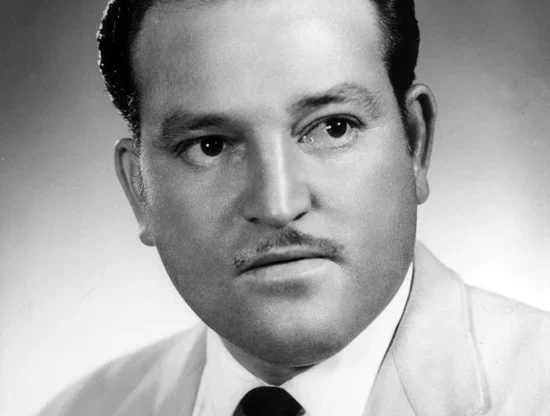
On September 14, 1923, orquesta bandleader Juan Mario Garcia, better known as Juan Colorado, was born in the South Texas town of San Diego.
The stage name “Colorado” came early, earned in the schoolyard from his red hair and freckles. It stuck through his teen years, when he played football and performed in the marching band at San Diego High. His musical education in the public schools paid off when Colorado joined Balde Gonzalez’s orquesta in the early 1950s, among the coolest and most sophisticated bands at the time. Balde Gonzalez was from Beeville, but his musical education came at the Texas School for the Blind and Visually Impaired in Austin, a veritable institution with a deep roster of classically-trained musical alumni. Gonzalez imparted these lessons to Colorado, a composer and multi-instrumentalist whose preferred instrument was the tenor sax.
Colorado’s flexibility and musicality led him to strike out on his own, as he formed his orquesta by the mid-1950s, taking with him another up-and-comer from Balde Gonzalez’s group in singer Isidro Lopez. Colorado wrote and recorded at Ideal Records with tracks including “Todo or Nada,” “Diganle,” and “Corazon del Pueblo,” but his rise was cut short, as he died young in winter 1957. Isidro Lopez took leadership over the group and soon became the most influential orquesta bandleader of his generation. The examples of Balde Gonzalez and Juan Colorado were always before him, and Lopez would record many Juan Colorado tracks in the course of his career.
Juan Colorado with Isidro Lopez, “Diganle”
Juan Colorado, “Entre Platicas”
Sources:
Manuel Peña. Musica Tejana: The Cultural Economy of Artistic Transformation. College Station: Texas A & M University Press, 1999.
Clay Shorkey in Laurie E. Jasinski, Gary Hartman, Casey Monahan, and Ann T. Smith, eds. The Handbook of Texas Music. Second Edition. Denton, TX: Texas State Historical Association, 2012.